Thursday, May 7, 2009
Dr. Strange and pop psychology


Wednesday, April 15, 2009
Why is it okay for Man to censor God?
Now, without going any further into the details of this parsha, doesn't this strike you as a bit graphic? I can only imagine what one of my critics would say about this imagery, if it were to be illustrated in comic book form. Too gross? Too graphic? But this ritual is at the core of our religion. Even though later, it was substituted with prayer (prayer being a sacifice of ourselves to God), we still have this very graphic imagery as part of our literary tradition. I always get a kick out of watching a little old granny approaching the bima to read a portion such as this.
Recently, Aline Kominsky Crumb spoke at our local JCC, and she let out the word that her husband, R.Crumb, has finished working a comic book version of Genesis, warts and all. I can't wait to see it. Imagine what he'd do with Exodus, with it's graphic descriptions of sacrifices to God. This is not to revel in the gore, but rather, to ask the question "Who are we to censor God's language?"
Saturday, April 11, 2009
Marvel Comics & the Passover Plagues, more entries!
Plague of Death of the First Born: Dr. Doom

Plague of Hail: StormPlague of Frogs: ToadPlague of Wild Beasts: BeastPlague of Darkness: Mysterio

Wednesday, April 8, 2009
Marvel Comics & the Passover Plagues
The Plague of the Pharoah (why not? Even though he's not regarded as a plague, he should be): Pharoah
Plague of Locusts: The Locust
Plague of Dead Livestock, Dead Fish, and Boils: The Plague (Bubonicus)
Plague of Dead Livestock, Dead Fish, and Boils (another version): Bacillus
Plague of Frogs: Leap Frog
Plague of Flaming Hail (well, actually just flame; I couldn't find flaming hail): Flame
Plague of Darkness: Dweller-In-Darkness
Tuesday, April 7, 2009
Theater of the Seder
As an artist, objects take on a symbolic significance. Oftentimes, the meaning of the symbols is very personal, only understood by you. But for passover, we all understand the meanings of the foods on the Seder plate: with as many senses as we can, we are reminded of the Passover experience, of our slavery in Egypt, of God's plagues against Pharoah, and our ultimate freedom.
I got to thinking about how far the symbolism went. Rabbi Jill Jacobs, in her article on the "My Jewish Learning" site, has a nicely organized breakdown of the meanings of the various foods. She even says something about their placement. Imagine, we don't just thank God for our food, but we also give each food a role in a choreographed table top theater. One thing that I like about Rabbi Jacob's article is that she concludes by inviting the reader to make the seder personal by bring an object that represents liberation to him or herself. Thus, her seder would involve a kind of show-and-tell experience.
Not that this would all be good. Once you get a table of us together, and inviting them to basically kvetch, it could go anywhere. Once you start talking about symbols of freedom, you're bound to start dwelling on stories of captivity as well. What if your seder guest's meaningful symbolic artifacts brought up bad memories? And then there all all of those cups of wine!
I wonder if this great tradition of having a seder, with its symbolic foods, doesn't point the way towards a more theatric and interactive type of literature? Suppose a trend caught on, where the authors of books would include food suggestions at various parts of their stories. I've heard of parties based on a theme from something in real life. But imagine that an author included a food shopping list with their books. That would take writing in a whole new direction: authors would have to write with flavors and aromas (maybe included as notes in the back of the book) Or imagine meeting with friends at a scene from a book, and ordering what one of the characters ordered from the menu.
Only someone who loved the seder would come up with nutty ideas like this.
Sunday, April 5, 2009
Moral Vision and Moral Confusion
It's not enough that God separated Darkness from Light in the early days of Creation. What we're thanking God for is our ability to tell the difference. But who can't tell the difference between darkness and light? Those who are blind. The prayer thanking God for opening the eyes of the blind immediatly follows the prayer thanking God for letting us distinguish darkness from light.
If were are take these prayers at face value, they are trivial, for it's obvious what the difference is between dark and light: one is defined by the other. Light = absence of Darkness, and vice versa. That same goes for the phrase "opening the eyes of the blind". If we were talking about those who are literally blind, then why would it even be in the siddur? Most of us can see; only a fraction of Humanity is without eyesight.
The only way to make sense of both of these prayers is on the metaphorical level. The concepts "dark", "light", and "blindness" have spiritual meaning only as it relates to our soul (that is, the seat of our emotions). I mean, the literal (or "simple") meaning of "light", "dark", and "sight" is nice enough; the world is filled with visual wonders, and our eyes allow us to appreciate them. But think about the moral meaning of these terms (light, dark, sight/vision): the siddur is advising us against moral confusion. We must pray to God that we maintain the ability to tell the difference between right and wrong, or else we're lost, blind, stumbling around in the dark with no direction home. Before you know it, you may be convincing yourself that Bad is Good, and vice versa. We should pray to God that we have a moral foundation, and that we don't forget who we are.
So how do you illustrate that in a comic book? By having a guy in a cape running out of an angry dark billowing cloud into a smiley happy bright sunshiney face.
Saturday, April 4, 2009
Why Get Pissed at the Prayer for Peeing?
In my book, the Comic Book Siddur", I illustrate this particular prayer with a guy sitting on a box, in an artistic reference to Rodin's sculpture "The Thinker". I pointed a word balloon to his mouth, with the text of the prayer reduced to: "Thanks God, for making me regular!"
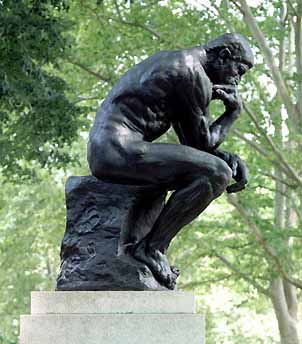
Surprisingly (or maybe not so surprisingly) some people find that illustration offensive. "You've got a guy sitting on a toilet!", a woman explanined to me; "I just think that it's in poor taste!" What baffles me is that my illustration of the prayer, and my english translation of it ("thanks for making me regular!") is much more tame than the actual english translation as found in the Art Scroll siddur. The "Asher Yatzar" prayer explicitly talks about bodily cavites being obstructed making it impossible to relieve oneself. That imagery gets into your head just by reading the prayer right out of the Art Scroll siddur. But in the Comic Book Siddur, it's all sanitized and euphemized, while still getting across the same idea. I don't show someone who's bodily orafices have been obstructed, who'd having an impossible time urinating or defacating. That imagery sprung from the original authors of the siddur. But when I come up with some counter-imagery, namely, a superhero sitting on a soapbox, musing about life (ala Rodin's "Thinker") suddenly I'm the one being offensive. And to think that the big problem with a comic book version of the siddur in the first place had more to do with the fact that it had illustrations. Some people are comfortable describing disturbing graphic scenes with language, but illustrating them -- even in a sanitized and euphemistic way --suddenly makes them objectionable? Go figure...