Saturday, June 25, 2011

Moses and his Hulk-like tendency to smash

 Why is Moses so short-tempered? Why does he have to take out his anger on precious objects? We're already familar with his smashing of God's tablets (upon seeng the Israelites dancing around a Golden Calf). Now, in Numbers, we've have the Israelites rebelling against Moses...and again, there's the Hulk-like tendency to smash.

In Numbers 20:2 (in Parshat Chukat) the Israelites are thirsty. They become hostile, and (as it is written) they turned against Moses and Aaron.  This provokes Moses to strike the rock of Miraba, which causes water  to pour out. The people have water,   but Moses falls from grace with God: He’s forbidden from entering into the Promised Land..

I’ve always been bothered by Moses’fate here: I’ve often felt that God was too harsh with Moses, forbidding Moses from entering the Promised, all because he lost his temper and stuck a rock with his staff. It was hot, people were dehydrated and complaining…But on closer reading,  I can see that scene is not simply about a leader losing his temper; it’s about ritual impurity, which is the theme that runs thoughout this entire parsha. Let’s look at this scene more closely:

First, as we learned in Leviticus 20:2, the people were without water.   They’re probably overheated and dehydrated, being in the desert.

Then, in the next line (Leviticus 20:3), some of the Israelites say something incredible.  When complaining to Moses for the lack of water,  they say, “if only we had perished when our brothers perished at the instance of the Eternal!

Perished at the instance of the Eternal? That’s an odd thing for an Israelite to say... unless it’s a clue about how to read what’s coming up next.  I think that it’s a reference  to the fate of Nadab and Abihu,

In line 20:6, we learn that the setting for this scene is actually before the Tent of Meeting. As it is written,  after Moses appeals to God for guidance, God gives Moses these instructions: “You and your brother Aaron take the rod and assemble the community, and before their very eyes order the rock to yield its water. Thus you shall produce water for them from the rock, and provide drink the congregation and their beasts”

I think that the proper way to read this scene. is that God is explaining a ritual to Moses. Moses is to perform the ritual,  God is to provide water from the rock, and the Israelites would praise God for His blessings.

It doesn’t work out that way.  In the very next line, Moses deprives God of the Israelites brucha (for providing water),  and also glorifies himself as a magician.  Angry with the Israelites for their complaining,  Moses says

“Listen, you rebels, shall we get water out of this rock?”, and Moses raised his
hand and struck the rock twice with his rod. Out came copious water, and their
beasts drank”

When Moses strikes the rock in anger, causing water  flow out of it, we’re supposed to look at this as analogous to Aaron’s sons bringing unholy fire into the Temple: it’s a form of ritual impurity.  The whole theme of this parsha is issue of ritual impurity

Many commentators have a hard time figuring out why God is so hard on Moses for this incident at the rock.  I’d like to suggest that if we view Moses’ angry outburst, and his striking of the rock, as a ritual violation,  perhaps that will shed some light on the subject.  Moses needs to be a better Moses! Moses not Hulk!

Sunday, March 20, 2011

"Inception", Dr. Strange, & Joseph: Three Dream Worlds

I just saw the movie "Inception", which is about an adventure that takes place in the "dreamworld". It's very much like the old Doctor Strange comics from the 1960's, which had a similar premise: two opposing forces fight it out in dreams. With Doctor Strange (at least in the beginning), troubled people would visit him in his office...but instead of offering psychological counseling or psychoanalysis, he would offer to enter the dream world of his patients by going into a trance, and then visiting his patients demons on their own turf: the world of the dream.

 Since Doctor Strange was a Marvel Superhero, he operated within a moral Universe: there was a force of cosmic Good, and a force of cosmic Bad. A superhero battle in the dreamworld of Doctor Strange thus represented a battle between Good Character (or Good Conscience) vs Bad Character (or Bad Conscience). This made Doctor Strange in interesting and compassionate character. Not only that, but Steve Ditko's artwork, which was a mash up of various schools of modern art (e.g. the surrealism of Salvidor Dali, the angular and geometric look of Russian Constructivism, and the graphic sharpness of Pop Art) So how disappointing that "Inception" has no moral core: it's has no heart. The plot involves some thieves who want to enter someones mind not to heal them, but to rip them off. The main character's motivation is to enter someones mind so he can get hold of a combination to a safe. How disappointing. (His secondary motivation is to convince his wife, who thinks that she's living in a bad dream, that she's not in a dream)

Compare the dreaming in "Inception" to incidents of dreaming of Joseph in the Torah. Joseph has several dreams, each which suggests that Joseph has a future of greatness, whereas his brothers do not. This so enrages Joseph's brothers, that they throw him in a pit, with the intent that he die. As it turns out, Joseph IS destined for greatness. He lives to meet his brothers again, this time as a ruler, and to have the chance to take the high road and reconcile with his brothers, who don't recognize him.

In "Inception", as in "Doctor Strange", the dream world is where the action takes place. Most of the movie is spent navigating the layers of the subconscious. It's got the logic of a video game: hit all your targets on one level before moving to the next level (of dreaming). But in the Joseph story, the dreams are incidental: they provide a motivation for his brothers to get jealous and angry, and thus set the story in motion. Although Joseph did have visions of greatness for himself, it didn't involve him achieving it by ripping off someone else.

Did anyone achieve any "wisdom" in Inception? No...it's all about accomplishing a mission. It's a very aggressive movie. In the Torah, when people dream, it's a sign from God; it's a forecast of the future; it's a sort of esoteric wisdom.  What about the dreams in Inception? Were they holy?. No, in this movie dreams are induced, forcibly entered, and then exploited.

 "Inception" would be far more interesting if it was a movie about sibling rivalry in the dream world. What would "Inception" be like if it used as its source Joseph's dreams of greatness? Suppose that Joseph had his dreams, and then his brothers plotted to enter those dreams in order to extract their revenge,(rather than extracting the ideas out of someone's head)  instead of throwing him in a pit? Perhaps Joseph would morph into Doctor Strange, so that he could confront brothers in his dreams. That would be interesting.

Monday, December 20, 2010

Exodus & Eugenics: The Mad Scientist as the new Pharoah archetype

When reading over parsha Shemot (actually, only the second paragraph, Exodus 1:8 - 1:12), which is the beginning of the Exodus story, I couldn't help feeling that Doctor Sivana (of the old "Captain Marvel" comic book series) is the modern face of Pharoah.

In the 1940's, there was a comic book series called "SHAZAM! The Adventures of Captain Marvel", which featured Billy Batson, Captain Marvel, and his arch enemy, the evil Doctor Sivana. Doctor Savana was continually thinking up plots to take over the world, enslave mankind, and beat Captain Marvel.

How illuminating a costume change can be! Normally, when reading the story of Exodus, I picture Pharoah as an Ancient Egyptian in period clothes: the head dress, the chin beard, the throne...  Envisoning Pharoah in that type of get-up keeps our view of Pharoah in the past. But today, in this brilliant and ominous world of science and technology, Pharoah would look much different. Today's Pharoah would be a mad scientist. (Where's the Mad Scientist as a character in today's culture? He seems to be absent) Doctor Sivana, of SHAZAM! fame, fits the bill perfectly; he's concerned with eugenics and a genocidal plot. How thoroughly contemporary.

In this parsha, we see a reversal of fortune for the Jews (or the Israelites, who are the proto-Jews)  As it says in the parsha, “A new king arose over Egypt who does not know Joseph”.   Immediately I’m suspicious. How could the new king not know Joseph? How could the new king not know the second-in-command in all of Egypt? I’d assumed that at that level of leadership, all of the big players would know each other.  But not the new king. So where did he come from? Who was he? I think that there was possibly some sort of coup back then, or at least some bad office politics. Suddenly, out of nowhere, a new king arrives who doesn’t know Joseph? 

In the next line, we see that the new king is obsessed with the Jews fertility rate.  He doesn’t even regard them as citizens of Egypt. Just look at the language in this line: “And he said to his people, ‘look, the Israelite people are much too numerous for us. Let us deal shrewdly with them so they may not increase”. “His people” doesn’t mean us. The king doensn’t even regard the Israelites as citizens of Egypt.

But what’s especially serious in that line I just quoted is that the king hatches a genocide plot to prevent the Israelites from creating successive generations.  Notice how the Pharoah says that he must deal shrewdly  with the Israelites, so that they may not increase. With the technology at Pharoah’s hands in those Ancient times, eugenics consisted of killing the Israelites male babies by drowning them as they were born, and throwing the fertile males into forced labor camps, inside of a “garrison city”, as it’s stated in this parsha. If Pharoah was alive today, imagine how much more shrewd he could be, with modern methods of making men sterile and women infertile at his disposable: radiation, chemicals, diseases, and other stresses.  Men and women who couldn’t conceive would never suspect that Pharoah had a hand in their biological misfortune.

I’m having a hard time getting past the first few lines of this parsha, because it seems impossible that a new king could arise in Egypt without having any knowledge of Joseph.  I’m also struggling with Pharoah’s fear of the Israelites. It seems to come from nowhere. Why’s he so afraid? 

I’m troubled by Pharoah’s ignorance of Joseph, and his paranoid campaign to wipe out the Israelites. Why's he so afraid of the Israelites? Where’s all of this paranoia coming from?  If you imagine Pharoah as Doctor Sivana, the answer becomes clear: Doctor Sivana's afraid that his evil plot will be uncovered!

Doctor Savana:  the new archetype for Pharoah??

Saturday, November 20, 2010

The Technical Specs of Jacob's Ladder??

I've been thinking about Jacob's dream, where he sees a ladder rising up to Heaven, with angels ascending and descending it. It just struck me: why do angels need a ladder in the first place? Can't they fly?  Forgetting that question for a moment, lets consider the technical specifications of a ladder to Heaven.

First of all, without any clarification in the torah, artists are free to imagine what the ladder to Heaven might look like. Artist William Blake created a beautiful painting about Jacob's ladder, but where does it even imply that the ladder is a spiral staircase under a tent??  Nowhere! (Although Blake's work does conjure up a dreamy image that does feel sacred) I , however, would like to examine the ladder as a ladder, without much embellishment. I'd like to consider the ladder as a LADDER! This means that it would look more like something you'd find at Home Depot, rather than at the Guggenheim.

Let's consider some physical facts when trying to visual Jacob's ladder.

Clouds are roughly a mile above the ground : about 6500 feet) (source: here) So, what should we consider when constructing a ladder that's 6500 feet high?

First thing I thought of was "how many rungs are on this ladder?" "How far apart should they be?"

I figured that government engineers might have some standards I could use as a starting point. According to the OSHA website, "The minimum clear distance between the sides of individual-rung/step ladders and the minimum clear distance between the side rails of other fixed ladders shall be 16 inches (41 cm)." (source: here --scroll to 1926.1053(a)(4)(i))
 
So...the answer to the question, "how many rungs are on the ladder to Heaven" is roughly 4333. (If you assume that the rungs are spaced apart accoring to OSHA standards (i.e. 16 inches apart) AND you take into account the width of each rung (I assumed a 2 -inch rung size), then the formula for number of rungs on the ladder to Heaven becomes...the length of earth to sky (i.e. 78000 inches), DIVIDED BY 18 (i.e. the number of inches from rung-to-rung; 16" being the OSHA standard for distance between ladder rungs + the width of each rung, which I've assumed to be 2 inches) comes out to roughly 4333 rungs.

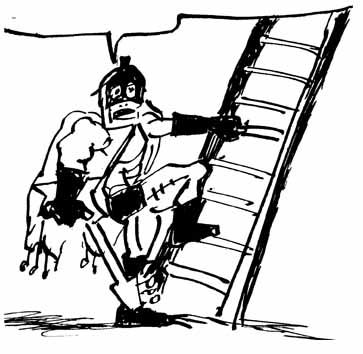
"This works out my leg muscles real good!" (image source: Comic Book Siddur)

Once I had a clearer vision of what an actual ladder to Heaven would have to require from an engineering standpoint, my vision of what the angels looked like started to change. Initially, a had a sweet vision of fresh faced choir members floating around the ladder, as if they were are all riding an escalator in a department store. 

A DRASH OF THE RIDICULOUS: Is there wisdom in laughter?
 
But as the details of the ladder came into clearer focus (due to my calculations), my impression of angels ascending and descending a ladder changed: I began to imagine what someone climbing up and down a ladder would look like: it's not as graceful as I'd initially imagined! I saw figures holding onto the ladder they would fall, straining to hang on as they strained to get up and down each step. Or do angels show signs of strain at all?   My image of angels ascending and descending a ladder to Heaven became more absurd and grotesque, the more literal I tried to make that vision.    I also began to worry about someone ascending and descending a ladder which was over a mile high. Yikes!

Jacob's dream had a meaning. So why does its "message" seem to change when I focus on the technical specifications of Jacob's Ladder?  Does my turning to OSHA standards make it ridiculous? Maybe...but why? There has go to be SOME specifications for a ladder. I mean, Bezalel was given very specific instructions from G-d re: how to build a tabernacle. So why should a ladder be any different?

Sunday, September 12, 2010

Scrolling Illuminated Screens VS. "Torah Interruptus"

What's worse: reading torah off of an illuminated scrolling computer screen, or out of a traditional paper book? The scrolling screen highlights a problem inherent with practically all prayer books: page turns interrupt kavanah.

Nowadays, we strive to have more kavanh...but apparently it wasn't always that way. The assumption that I've heard from at least one Orthodox Rabbi, is that the closer in time you are to Moses receiving the tablets from God, the more spiritual you are; in the legends of yesteryear, that is when the Jewish people were more spiritual than they were today. Last week, at our Temple's Shabbat service, the rabbi weighed in on the question of "why don't young Jews feel connected to Judaism?" There were a variety of theories, none of which (curiously) actually asked young Jews themselves for their opinion. I have an opinion, and it's based on my own experience. And it doesn't just address the current young generation, but focuses on a problem that has plagued our services for a long time. That is, the interruption. We call ourselves the "People of the Book", but there's a problem with books: they have pages. Every page turn is an interruption. Is it just me? Or am I the only one trying to keep up with the pace of the prayer service, or struggling to find where we are in the prayerbook.

Of course, one could get lost in a torah scroll too (I've seen it happen!), but the one new idea I thought I'd bring to this blog today is: turning pages in a prayerbook creates and interruption in the congregant's concentration. How lovely, a nice collection of prayer books! But if you lose your place, you're kinda stuck...until you find your place again. As I mentioned a moment ago, even if we used scrolls instead of prayer books, we might still lose our place, and this interruption would mess with our kavana.

When I started writing this, I had a grand idea that the interruption of the page-turn is a significant factor in the history of Jewish spirituality...or at least contributed to the current day problem of young Jews not feeling as "Jewish" as their forebears (is this actually true??)

I don't know what to believe. All I know is that this blog has two advantages that a prayerbook doesn't: scrolling text, and an illuminated screen. I feel that this is an important development in the history of Jewish spirituality, but I'm not sure if it's a good development or a bad one. 

Why am I even thinking like this? Because the Rabbi mentioned that some congregations ("in California") didn't use a prayerbook at all, but rather, converted their prayer book into a PowerPoint presentation, which included a bouncing ball. I asked the elderly congregant behind what he though of a PowerPoint prayer service; he loved the idea! He could see the words clearly, and you could focus on singing, instead of fussing with the book. I then began to wonder, what's stopping us from doing this at our Temple? We've got the technology. I think one reason is because the image of a book is very precious to us Jews.

Well, I've had some experience bucking tradition in the sacred realm, by writing and publishing the Comic Book Siddur. Just as with the electric nose-hair trimmer, people laughed at first, but then...it caught on! Why? Because it's useful, and people felt that it filled a need. So why do we still use traditional hard cover prayer books, when page turns alone are messing with our kavanah? Why doesn't the Reform movement embrace the PowerPoint Shabbat with open arms and laser pointer? Because we have made idols of books. Isn't there an argument to made that a PowerPoint prayer service is more like the Godly image of "black fire on white fire" because light, after all, is radiant energy, similar to light of a light projector??

If we want to increase kavanah at services, and if we want young Jews to "feel" more Jewish (and thus, cultivate an identification with Judaism and Israel) then we should remove the impediments to kavanah, that is, those things that give us torah interruptus.

Saturday, August 28, 2010

Kierkegaard's "Fear & Trembling": Isaac is the real existentialist hero

After years of hearing about Soren Kierkegaard's "Fear and Trembling", I finally decided to read it, and I found it excellent. This 150 year old book, for those who don't know, is about the Jewish story known as the "Akeida", where God commands Abraham to sacrifice his son. I find it very difficult to accept the fact that Abraham "proves" his faith in God by showing that he follows God's command without question. Thus Abraham is held up as a model "believer", as someone who doesn't question God's commands. I'm not the only one who struggles with passage. Kierkegaar'd book "Fear and Trembling" is all about the difficulties with this story. I feel he is a kindred spirit! My commentary here takes its cues from Kierkegaard's focus on Isaac.

Abraham is held up as a virtuous figure, yet we really don't know what kind of struggle he went through to bring himself to do this. But regardless, whatever the moral struggle Abrahem might have had, we know what his decision is: to sacrifice his son. I'll say it plainly: this is the WRONG answer. Abraham failed the test. I'm sure that God would have looked upon Abraham just as favorably had Abraham chosen to SPARE his son. If fact, by agreeing to sacrifice his son, Abraham has proven that he is a pagan. But God's command of Abraham is a test after all, right? Had Abraham rejected God's command that he kill his son, God could have just have easily praised him for his decision; for his independence of judgement, for his compassion, and for his moral courage. But no; Abraham is a lesser man because of his blind obedience.

As we read through the torah, we find plenty of examples where God proves to be open to suggestion. One can only wonder what might have happened had Abraham rejected God's command, or at least tried to strike a deal. My guess is that God would have regotiated with Abraham, saying, "tell you what, Abe, how about if you just sacrifice a ram instead?" Some things we just can't, in good conscience, ask people to do. God's request of Abraham, I feel, falls into that category.
Don't forget that Abraham had his son when he was a very old man. And now, he's commanded to kill his son? It's just gross. What's even more disturbing about this story is that no consideration is given to Isaac. How can Isaac have any faith in God, when God has basically sentenced him to die? And for no fault of Isaac's?

Kierkegaard is often held up an an existentialist writer, and surely, the person who is confronted with the existentialist dilemma is not Abraham, but rather, Isaac. Isaac has to live with the fact that God commanded him to die; not so, Abraham. How is Isaac to live the rest of his life, knowing that he's been used as a pawn by God? Abraham is commanded to kill his son, and he doesn't question it. For that, I feel, he is diminished. Isaac, on the other hand, must muster up the courage to go on with life know that God has singled him out to die (the subject of a cruel "test").
I feel that we could learn a lot if, when studying the Akeida, we focus on the existential predicament of Isaac. If you think about it, Isaac too, has been "chosen" by God. I'd say that Abraham represents the "old" faith (where he's commanded to obey), and Isaac represents the "new"; Isaac has to choose to follow God, when he's been given a really good reason no to.

Thursday, July 15, 2010

The Rothko Chapel as a Spirtual Comic Book

Recently, I went to Houston, TX to see the famous Rothko Chapel: a small, octogonal shaped room, whose walls are covered with massive dark dark paintings by famed minimalist abstract expressionist painter, Mark Rothko. This gallery-in-the-round is intended to have spiritual (if not religious) resonance for anyone who views it, yet the paintings do not contain any specfically religious imagery. In fact, they are pre-religious: they speak for the cosmic silence, the feelings of awe and infinity and vastness of God and the Universe by illustrating...nothing. Nothing but a black void.


When people first see they work, they think that it is black in color, but after you spend time there, you realize that they are very dark shades of green, red, and purple -- it's just that when colors are very dark in tone, the eye initially regards those colors as black. (In the above image, you'll notice that rather than three "black" paintings, there is actually a red painting flanked by two that are darker and more green)

Once you look into the paintings, however, they start to MOVE. There is actually a sensation of roiling movement, as if one is looking into a churning swamp. But what causes this movement on a still painting? At first I thought that there was something being projected on the canvases, say, a "camera obscura" effect from the skylight; perhaps light from outside was projecting movement from clouds and traffic outside down onto the paintings inside the chapel, with the monochromatic paintings serving as a dark movie screen? When I asked a docent/guardian in the chapel anbout this illusions, she suggested that it could be air turbulence from the AIR CONDITIONING!) I realized, after staring at Rothko's massive void-like paintings that the apparant movement in his work was an optical illusiion, caused by our eyes confusing the complimentary colors of green and red at extremely low shades or values, and then trying to make adjustments in order to properly perceive the color. After staring at his paintings at close range, I could see that they were made with layer upon layer of washes of green on red, over and over, back and forth...until the painted surface approached a black color. I hypothesized that when red and green are damped down to an extremely dark color, our eyes experience a sort of color blindness, for at very dark values, we can't distinguish a warm color from a cool color; we can't tell the difference between dark green and dark red. The result: a dark smouldering roiling effect optical effect, similar to clouds of oil spewing from miles down below the ocean's surface. Hard to believe, until you actually experience this optical illusion: it's truely amazing. Then again, it could be just "spiritual mojo", and I'll accept that without argument.

To those who have an interest in comic books, you might notice that the way that Rothko's arranged his massive paintings is similar to a comic strip. You can stand at one side of the room and "read" the paintings in a continous "strip" format. There is a triad of triptychs, at three points in the room; the triptych is a stand comedic comic strip format, in the question-answer-punchline formula. Also, the green and red colors reminded me of 3D comics from the 1950's. His subject matter was spiritual, but his composition was very much like comic book panels--each painting is either a full-page splash panel, or a two-panel page layout, and in the chapel, he's clustered three sets of them into three-panel "strips".

When sitting right upon the three massive paintings at the front of the chapel, I sense that Rothko actually had an impish sense of humor (or enormous feeling for the power of the artist) for at that perspective, sitting on the beanbag cushion on the floor (not pictured), I feel as if I'm sitting in a chapel to ART itself. While there are no religious icons or imagery in the chapel, there are undeniably PAINTINGS in the chapel. The chapel serves as a place to contemplate the infinite, as well as the phenemon of art itself. Is the Rothko chapel thus a place to worship art as ART (i.e. as an honest encounter for what these objects really are (i.e. PAINTINGS), and not as a simulation of an actual void)? Do we encounter the divine as an esthetic experience? Is there something about the three-paneled comic strip style of rhythm at work in Rothko's paintings? The Rothko chapel is undeniably a sacred space: a sacred place for you to fill-in-the-blank.